
Dalal Street had a roller coaster ride in 2024 from shattering record after record to facing heavy correction off-late but equity markets still rewarded investors with positive returns, driven by a surge in domestic fund flows and a resilient macro landscape. The first half of the year saw robust corporate earnings, a surge in domestic flows, and a resilient macro landscape, driving the Nifty to an all-time high of 26,277.35 in September 2024, according to Motilal Oswal Wealth Management.

India registered its protest at the board of IMF, which met on Friday to review the EFF lending programme for Pakistan.

After a robust 2023, foreign investors significantly scaled back their investments in Indian equities in 2024, with net inflows amounting to over Rs 5,000 crore, as elevated domestic valuations, coupled with geopolitical uncertainties prompted investors to adopt a more cautious stance. Looking ahead to 2025, FPI flows into Indian equities could see a recovery, supported by a cyclical upswing in corporate earnings, particularly in domestic-oriented sectors like capital goods, manufacturing, and infrastructure, Vinit Bolinjkar, head of research, Ventura Securities, said.

From the 30 Sensex pack, State Bank of India, Mahindra & Mahindra, Bharti Airtel, Titan, HDFC Bank, IndusInd Bank, Axis Bank and Bajaj Finance were the biggest laggards. JSW Steel, Tech Mahindra, Larsen & Toubro, Hindustan Unilever, HCL Technologies and Reliance Industries were among the gainers from the pack.

Mumbai -- home to industry titans and Bollywood stars -- is witnessing a slow offtake of houses priced between Rs 10 crore and Rs 50 crore. Industry insiders and real estate watchers explain why.

The rupee tumbled 3 per cent against the US dollar in 2024 as concerns over slower economic growth and a stronger greenback in global markets weighed, but it was among the least volatile currencies in the world and the headwinds may be less intense in the coming year.

Maruti Suzuki India Ltd (MSIL), the largest passenger vehicle manufacturer in India, has set a road map to expand its global presence by targeting exports of 800,000 units by the end of this decade -- almost double the approximately 280,000 units sent abroad in 2023-24, Rahul Bharti, executive director, corporate affairs, told Business Standard. The company's upcoming electric vehicle (EV) strategy is expected to play a crucial role in its global ambitions.

Sharif said that the US president had shown beyond any doubt that "he is a man for peace... and beneficial business deals".

Inflows into equity mutual fund (MF) schemes declined in May, logging their lowest tally in 13 months at Rs 19,013 crore. It came even as the gross systematic investment plan (SIP) inflows surged to a record high of Rs 26,688 crore.

Amid volatility in stock markets generated by tension between Russia and the US over Ukraine, LIC chairman M R Kumar on Monday said that the insurance behemoth was watching the geo-political situation carefully, though it was keen on listing of the IPO in March. The Life Insurance Corporation (LIC) has already filed the DRHP with the Securities and Exchange Board of India (SEBI) for its initial public offering (IPO). "We are watching the situation closely and carefully...but we are very keen on having listing in March," Kumar said, when asked about the impact of the evolving geopolitical situation on the upcoming IPO.
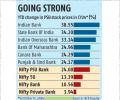
Stock Market News today, PSU banks: The year 2024 was a roller-coaster ride for Indian stock markets, marked by volatility driven by the Lok Sabha elections, Union Budget 2024, a slowdown in corporate earnings, and sticky inflation. Geopolitical tensions - particularly between Israel and Iran in West Asia - along with various stimulus announcements by China and yen carry trade rocked the equity markets throughout the year.

India's flexible (flex) office segment, having breached pre-pandemic levels, is thriving as corporates, startups, multinational corporations, and global capability centres (GCCs) expand in India, seeking low-capital yet Grade A plug-and-play facilities. In the first quarter (Q1) of 2025, the flex office segment continued to grow, with flex space leasing rising by 22 per cent to 2.2 million square feet (msf), according to Colliers.

'Gold prices thrive on volatility and more so when the stock markets trend downward.'

HDFC, HDFC Bank, Reliance Industries and Infosys fell up to 2.20 per cent, dragging the indices deep into the red.

A year after a Hamas attack against Israel on October 7 and the ensuing Israeli invasion of the Gaza Strip, India's trade with most West Asian countries has largely escaped any major disruption, except with countries like Israel, Lebanon, and Jordan. However, repeated flare-ups of geopolitical tensions in the region continue to drive up shipping and logistics costs.

At the 1972 Munich Olympics 11 Israelis were killed by Palestinian militants in an attack on the Olympic village where they were staying.

Sun Pharma, Tata Steel, State Bank of India, Axis Bank, Tata Motors, Larsen & Toubro and ICICI Bank were also among the Sensex gainers. HCL Tech, UltraTech Cement, Nestle and Hindustan Unilever were among the laggards.

Analysts expect Nifty to rise up by to 6 per cent in six months, with intermittent corrections likely due to global factors.

'Investors with foreign currency-denominated goals, such as foreign education or foreign travel, should go for US equity funds.'

The institute currently has a faculty exchange programme with some Turkish institutions.

Apart from the emotional value attached to buying gold, the yellow metal offers protection against inflation, interest rate spikes, currency and geopolitical risks, says Anamika Pareek.

'India enjoys conventional superiority, but nuclear deterrence imposes clear boundaries.'

Invest with a 5 to 7 year horizon so that you are able to ride out price volatility and benefit from the long-term trends of demand and macroeconomic shifts.

For the first time, the event will take place across three locations in Delhi: Bharat Mandapam at Pragati Maidan, Yashobhoomi Convention Centre at Dwarka, and India Expo Mart at Greater Noida.

Smartphones have been a key success story of the government's production-linked incentive scheme, helping India become the second-largest mobile phone manufacturing country, after China.

In the short run, the Trump presidency has already ensured one thing: The assumptions of the past can no longer guide the strategies of the future, points out Manish Dabhade.

AI-driven and deepfake-enabled cyberattacks are anticipated to become increasingly prevalent in 2025 with sectors like healthcare and finance most prone targets, according to a recent report. The India Cyber Threat Report 2025 by the Data Security Council of India (DSCI) and Seqrite, spotlighted the evolving tactics of cybercriminals and the rise of AI-driven attacks as a major concern. "Artificial Intelligence (AI) will be used to develop highly sophisticated phishing campaigns utilising deepfake technology and personalised attack vectors, making them harder to detect.

The Reserve Bank of India (RBI) has identified "climate shocks" as a risk to food inflation rates and overall price rise while stating that the outlook for the country's economic growth remains bright. In its Annual Report for 2023-24, released on Thursday, the central bank said easing supply-chain pressures, broad-based softening in core inflation, and early indications of an above-normal southwest monsoon meant well for the inflation outlook in 2024-25. "The increasing incidence of climate shocks, however, imparts considerable uncertainty to the food inflation and overall inflation outlook," said the RBI while noting headline inflation moderated by 1.3 percentage points on an annual average basis to 5.4 per cent in 2023-24.

US strikes on Iran's three main nuclear facilities have once again raised concerns that Tehran might shut down the Strait of Hormuz - one of the world's most critical chokepoints, through which a fifth of global oil and gas supply flows.

Housing demand should improve nationwide after the Reserve Bank of India (RBI) cut the repo rate by a larger-than-expected 50 basis points (bps) on Friday, said real estate industry executives. The rate cut comes after housing sales in top Indian cities in the first quarter of 2025 dipped 28 per cent due to skyrocketing residential property prices and geopolitical headwinds, according to Anarock.

Maruti, IndusInd Bank, Bajaj Finserv, Eternal, Mahindra & Mahindra, Tata Steel, Kotak Mahindra Bank, Titan, HDFC Bank, and NTPC were among the other major gainers. Bharti Airtel and Sun Pharma were the laggards.

Gold prices advanced Rs 700 to reach a new lifetime high of Rs 91,950 per 10 grams in the national capital on Wednesday on the back of continued buying by jewellers ahead of wedding season, according to the All India Sarafa Association. Besides, increased tensions in the Middle East and concerns about the US economic slowdown have kept the demand for safe-haven assets intact.

Investors should tilt their portfolios towards domestic-facing defensive sectors, which should help provide stability and shield them from geopolitical and tariff risks.

'India represents one of the top opportunities with robust growth, solid fundamentals, and openness to foreign investment.'

The Reserve Bank of India's (RBI's) State of the Economy report for October acknowledged a slowdown in some high-frequency indicators but expressed confidence in a recovery, aided by consumption demand during the festival season. "In India, aggregate demand is poised to shrug off the temporary slowdown in momentum in the second quarter of 2024-25 as festival demand picks up pace and consumer confidence improves," said the report released on Monday.

India's merchandise exports in April 2024 marginally rose to $34.99 billion from $34.62 billion in the year-ago month, according to government data released on Wednesday. Imports too increased to $54.09 billion from $49.06 billion in April 2023.

Prices may go up because of higher energy costs, caused by the rise in shipping charges, with commercial vessels taking a longer route to avoid the troubled Red Sea region, the finance ministry said on Monday. Iran-backed Houthi rebels of Yemen are repeatedly attacking ships in the Red Sea. While the global economy is grappling with challenges such as sticky inflation, sluggish growth, and mounting fiscal pressure, India's external sector could face "potential risks" due to the ongoing geopolitical tensions, according to the finance ministry's report on the review of the Indian economy.

'Granting the country's highest civilian honour to Prime Minister Modi was surprising as it indicated the government was going out of its way to have India as a close partner.'

'In the new coalition government, India's reform agenda may prioritise job creation and factor market reforms.'

Gold future prices sustained upward trend for the fourth straight session by surging Rs 2,048 to hit a fresh record high of Rs 100,000 per 10 grams as investors rushed to safe havens after US President Donald Trump indicated plans to overhaul Federal Reserve amid continuing global trade war jitters. On the Multi Commodity Exchange (MCX), the August delivery contract of the yellow metal bounced by Rs 2,048 or 2.1 per cent to hit a fresh peak of Rs 100,000 per 10 grams in the mid-session trade.
